
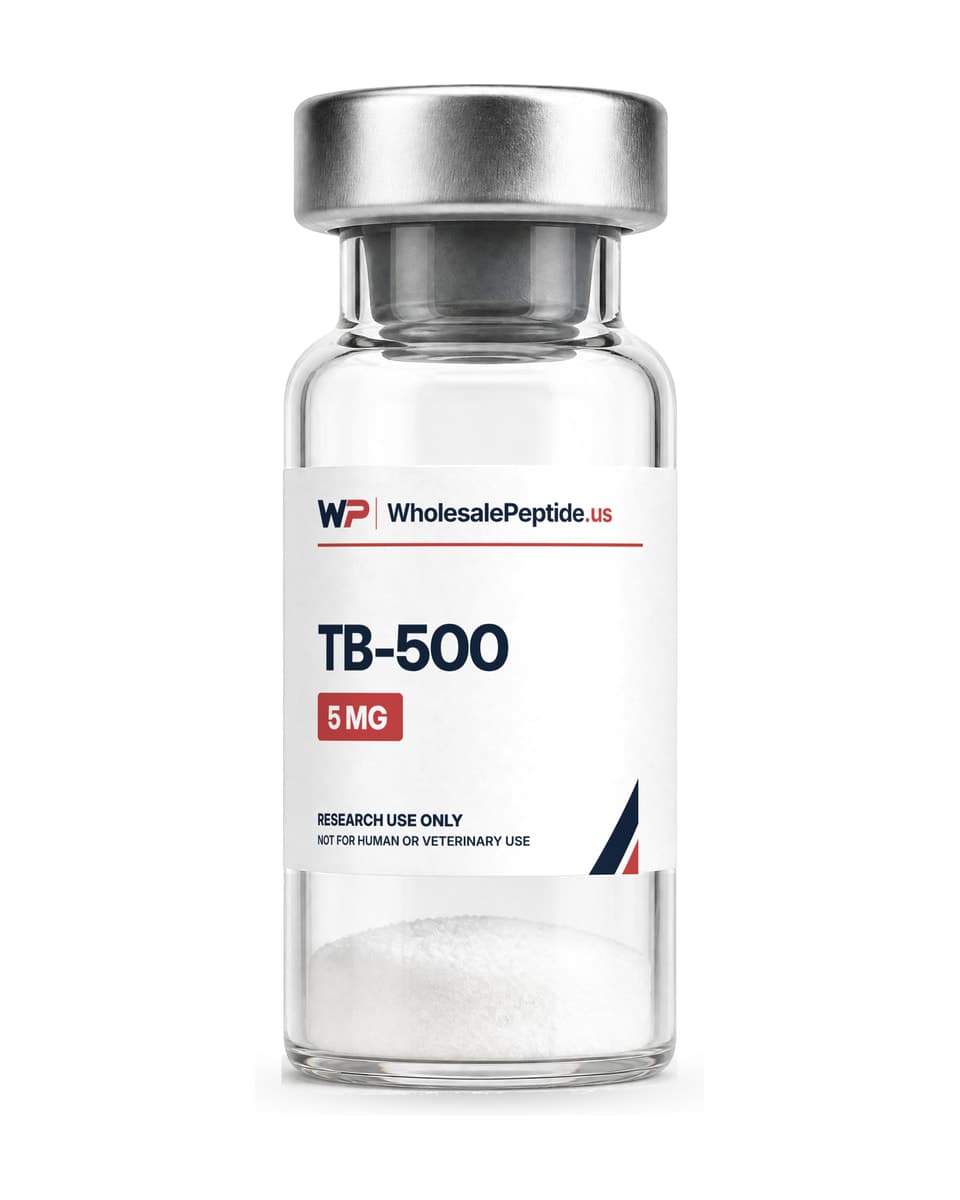
TB-500 (Thymosin β-4 fragment)
Tissue-repair research peptides
5 mg · 10 mg
From
$28.50 / vial
Research use only
For laboratory research use only. Not for human or veterinary use.
Paid by 2:00 PM ET Monday–Friday ships the same day · Free U.S. shipping over $500
BPC-157 (CAS 137525-51-0, C62H98N16O22, 1,419.5 g/mol) is supplied by WholesalePeptide.us in 10-vial kits of 5 or 10 mg lyophilized powder. Every lot is tested by an independent third-party laboratory (RP-HPLC purity and LC-MS identity); A lot-specific Certificate of Analysis is published before the lot ships. List price for 5 mg is $270.00 per kit ($27.00 per vial), with discounts at 3, 10 and 50 kits and a quote from 100 kits. Minimum order is one kit. Research use only; not for human or veterinary use.
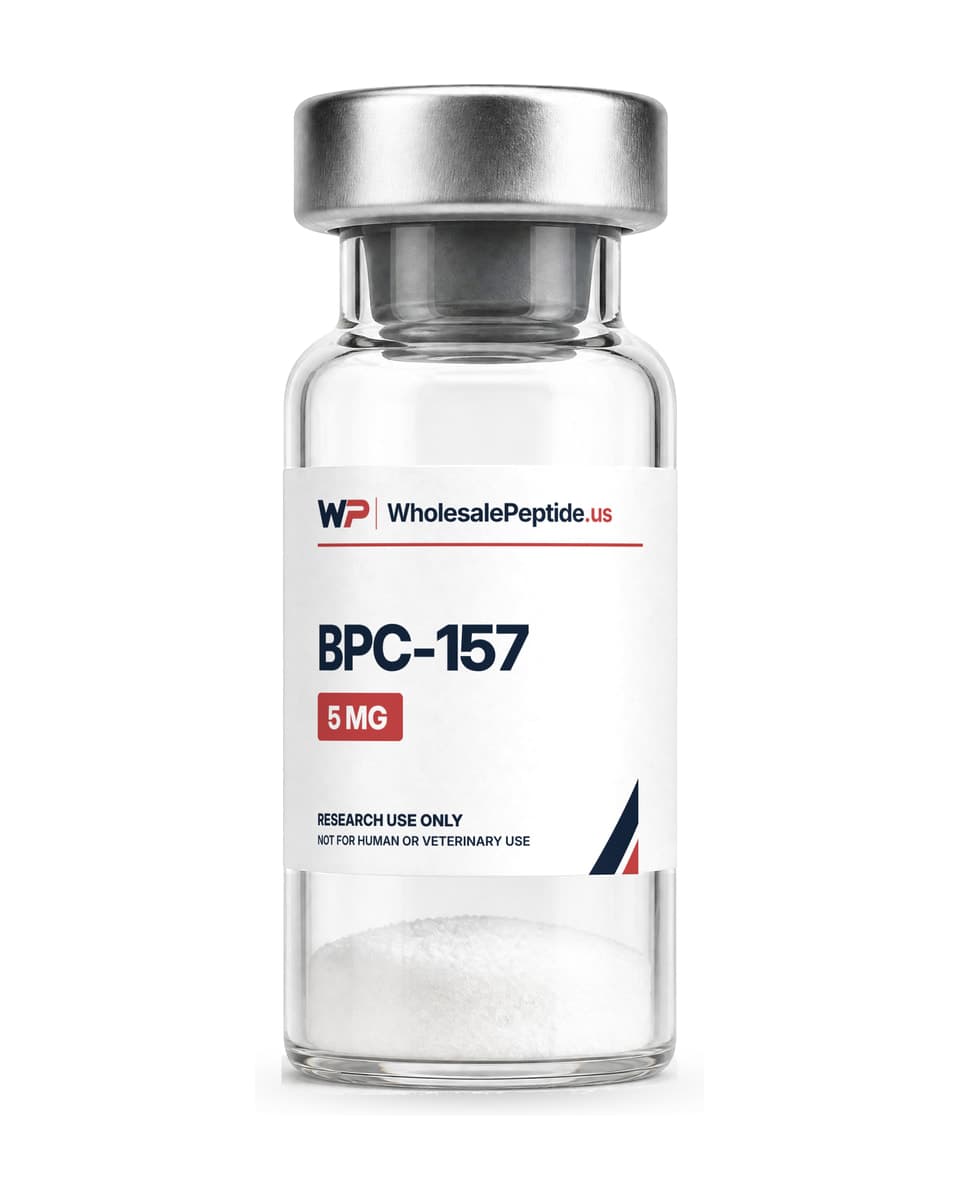
Illustrative product image. The label on each physical vial carries its lot code.
The discount is set by the total kits in your order across all compounds. Per-vial price = kit price ÷ 10.
| SKU | Strength | 1–2 kits | 3–9 kits | 10–49 kits | 50–99 kits | 100+ kits |
|---|---|---|---|---|---|---|
| WP-BPC-5Backorder | 5 mg × 10 | $270.00 $27.00 / vial | $256.50 $25.65 / vial | $243.00 $24.30 / vial | $229.50 $22.95 / vial | Quote |
| WP-BPC-10Backorder | 10 mg × 10 | $320.00 $32.00 / vial | $304.00 $30.40 / vial | $288.00 $28.80 / vial | $272.00 $27.20 / vial | Quote |
Compare every SKU on the wholesale price list.
Certificate of Analysis — current lot
A lot-specific Certificate of Analysis is published before the lot ships. Lot record and lab report from an independent third-party laboratory will appear here.
Certificate of Analysis — current lot
A lot-specific Certificate of Analysis is published before the lot ships. Lot record and lab report from an independent third-party laboratory will appear here.
All certificates: COA library · how to read a peptide COA · testing and quality · HPLC vs mass spec · storing lyophilized peptides
BPC-157 (Body Protection Compound 157) is a synthetic 15-amino-acid peptide, GEPPPGKPADDAGLV, derived from a sequence in a protein isolated from gastric juice.
| Also known as | Body Protection Compound 157 |
|---|---|
| Class | Synthetic pentadecapeptide (gastric-protein-derived sequence) |
| CAS number | 137525-51-0 |
| Molecular formula | C62H98N16O22 |
| Molar mass | 1,419.5 g/mol |
| Length | 15 amino acids |
| Sequence | Gly-Glu-Pro-Pro-Pro-Gly-Lys-Pro-Ala-Asp-Asp-Ala-Gly-Leu-Val (free acid) |
| FDA UNII | 8ED8NXK95P (FDA GSRS) |
| Registry record | PubChem CID 9941957 |
| U.S. status | Not approved by the FDA for any use |
| Supplied as | 5 mg or 10 mg per vial · 10 vials per kit · lyophilized powder, single compound, single strength · 99%+ purity (RP-HPLC) |
WholesalePeptide.us is a U.S. BPC-157 supplier and vendor for laboratories, distributors and research resellers. Kits ship from Sheridan, WY by UPS / USPS, tracked; orders paid by 2:00 PM ET Monday–Friday leave the same day, typical transit is 1–4 business days, and orders over $500 ship free. Every kit label carries the lot code that matches its certificate from an independent third-party laboratory. For BPC-157 in quantities of 100+ kits, request a bulk quote; for your own label see private label peptides.
BPC-157 is a linear pentadecapeptide first described by Sikiric and colleagues at the University of Zagreb in the early 1990s as a 15-residue fragment of a larger gastric-juice protein of about 40 kDa that the group called BPC, for body protection compound. It contains no disulfides or non-standard residues, is unusually stable in gastric juice for a peptide of its size, and is supplied as the free acid.
Molecular character. The sequence GEPPPGKPADDAGLV is unusual in being proline-rich (five prolines in fifteen residues, including a PPP run) with no aromatic residues and no cysteines. The proline content gives it a conformationally restricted, polyproline-like backbone, part of why it resists gastric proteolysis, and it also has analytical consequences: proline-rich peptides can show broad or split RP-HPLC peaks from slow cis/trans isomerization, and the lack of tryptophan or tyrosine makes UV detection at 280 nm impractical, so low-wavelength or mass detection is used instead. Unlike a hormone with a defined receptor, published work describes BPC-157 as a cytoprotective agent, not as the ligand of a single identified receptor.
Almost all published work on BPC-157 is preclinical. Studies in rodent and cell models examine its effects on angiogenesis, nitric-oxide signaling, VEGFR2 activation, tendon and ligament tissue-repair models, and gastrointestinal mucosal models. A 2025 systematic review in orthopaedic sports medicine included 36 studies, of which 35 were animal or laboratory work, and the only registered interventional human study listed on ClinicalTrials.gov, a Phase 1 safety and pharmacokinetic study of an oral tablet formulation (NCT02637284, sponsor PharmaCotherapia d.o.o., started October 2015), carries an unknown status with no posted results. That imbalance between animal and human data is why it remains a research compound.
Mechanistic work at the cellular level. The most reproducible finding is an effect on angiogenesis through VEGFR2. In endothelial-cell experiments BPC-157 increased VEGFR2 mRNA and protein without changing VEGF-A, promoted VEGFR2 internalization, and activated the VEGFR2–Akt–eNOS axis; both the signaling and the endothelial tube formation were blocked by dynasore, an endocytosis inhibitor, placing receptor internalization upstream of the signal (Hsieh et al., Journal of Molecular Medicine, 2017). Separate work describes effects on the Src–caveolin-1–eNOS pathway and on vasomotor tone. Standard assay formats in this literature are the chick chorioallantoic membrane assay, endothelial tube-formation assays, and laser-Doppler perfusion measurement in rodent hind-limb ischemia models.
U.S. regulatory status: BPC-157 has never been approved by the FDA for any use. Its compounding status has moved several times. FDA placed BPC-157 in Category 2 of the interim 503A bulk drug substances policy, the category for substances with identified significant safety risks, citing immunogenicity risk for certain routes and limited safety-related information; FDA's current page lists it among substances whose nominations were withdrawn by the nominators. FDA's Pharmacy Compounding Advisory Committee then took up BPC-157-related bulk drug substances at its meeting of 23–24 July 2026, announced in the Federal Register. On 30 October 2026 HHS published notice of an enforcement discretion policy for 503A compounding using certain peptide bulk drug substances while the 503A bulks list is developed through rulemaking; that notice is a statement of enforcement intent, not an approval, and the substances it covers are listed in its appendix rather than in the notice itself. None of this changes what WholesalePeptide.us sells: BPC-157 is supplied only as a research compound for in-vitro and preclinical laboratory research.
Analytically, BPC-157 is a simple molecule to verify: a single linear chain of standard amino acids whose theoretical monoisotopic mass can be calculated from the sequence above and checked against the LC-MS line on the COA. Proline-rich sequences can show broadened RP-HPLC peaks from cis/trans isomers, which a full chromatogram makes visible.
U.S. regulatory status of the compound (as an active ingredient): Not approved by the FDA for any use. The material sold here is a research reference chemical, not a drug product.
The CAS number of BPC-157 is 137525-51-0. Its molecular formula is C62H98N16O22 and its average molar mass is about 1,419.5 g/mol. FDA UNII: 8ED8NXK95P. PubChem CID: 9941957.
BPC-157 has an average molar mass of about 1,419.5 g/mol (1,419.5 Da). On a lot COA, LC-MS should report an observed mass that agrees with this within the lab's tolerance.
BPC-157 is a 15-residue peptide. Sequence: Gly-Glu-Pro-Pro-Pro-Gly-Lys-Pro-Ala-Asp-Asp-Ala-Gly-Leu-Val (free acid).
Yes. WholesalePeptide.us sells BPC-157 from one kit upward in 10-vial kits. Published discounts start at 3, 10 and 50 kits, and orders of 100+ kits are quoted. It is also stocked pre-blended with TB-500 and in the GLOW blend. Research use only.
BPC-157 lots ship at 99%+ purity by RP-HPLC with identity confirmed by LC-MS. Each lot is tested by an independent third-party laboratory. A lot-specific Certificate of Analysis is published before the lot ships. The expected monoisotopic mass of the free acid is printed alongside the measured value.
No. BPC-157 is not approved by the FDA for any use. WholesalePeptide.us sells it as a research compound for laboratory research use only, not for human or veterinary use.
BPC-157 is a 15-residue peptide derived from a gastric-juice protein, and published preclinical work describes broad cytoprotective and pro-angiogenic activity with no single identified receptor. TB-500 is a synthetic fragment of thymosin β-4 whose described mechanism runs through actin binding and cell migration. The animal literature for BPC-157 emphasizes gastrointestinal and tendon models; for TB-500, cell-migration, dermal and cardiac models. Neither is FDA-approved, and WholesalePeptide.us supplies both for laboratory research use only, including as a pre-blended kit.
BPC-157 ships as lyophilized powder in sealed vials via UPS / USPS, tracked. Orders paid by 2:00 PM ET Monday–Friday leave the same day from Sheridan, WY. U.S. destinations only.
Tissue-repair research peptides
5 mg · 10 mg
Research use only
Tissue-repair research peptides
50 mg · 100 mg
Research use only
Back to wholesale peptides · full catalog · pricing
For laboratory research use only. Not for human or veterinary use.
For laboratory research use only. Not for human or veterinary use. By continuing you confirm you are buying for laboratory research.