
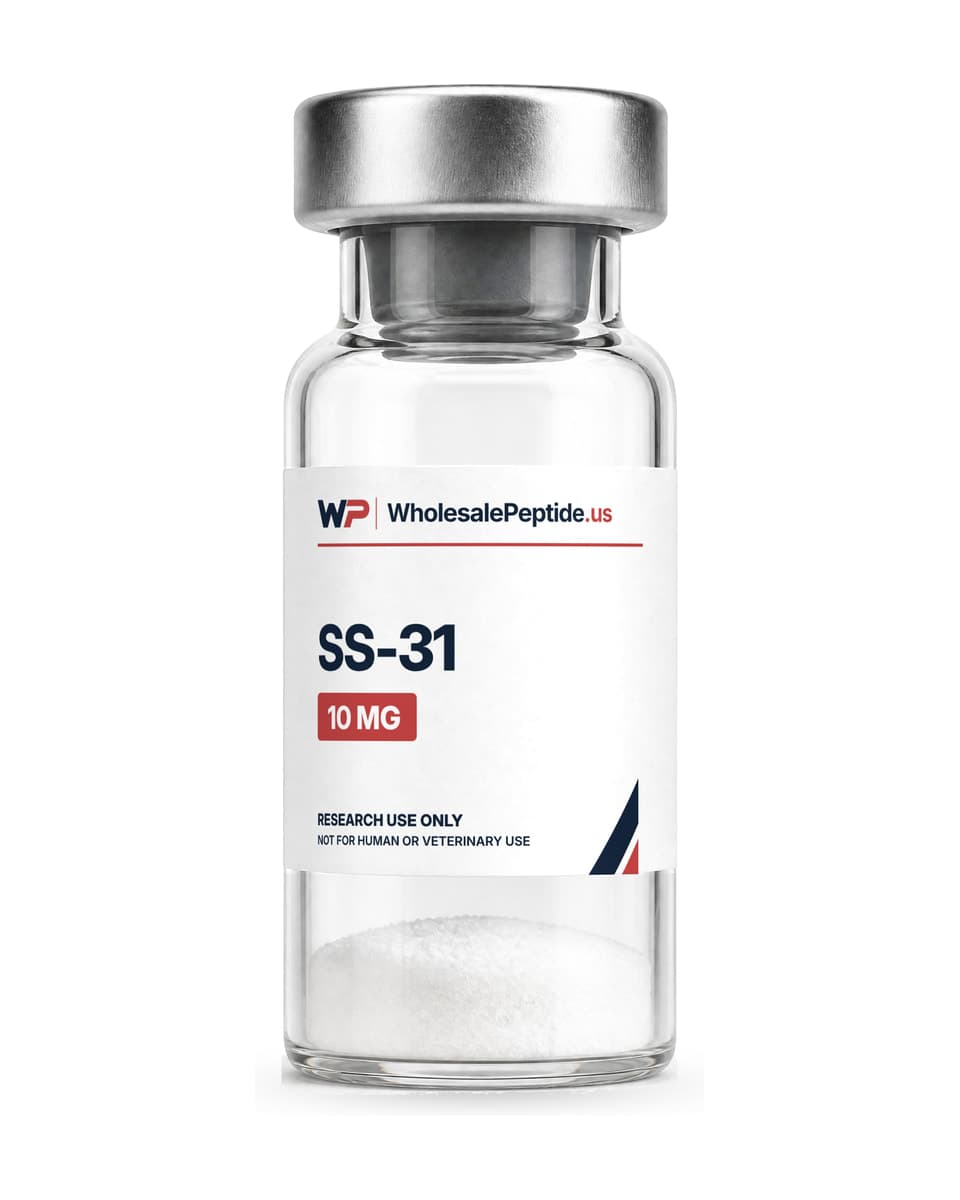
SS-31 (Elamipretide)
Metabolic and mitochondrial peptides
10 mg · 50 mg
From
$34.50 / vial
Research use only
For laboratory research use only. Not for human or veterinary use.
Paid by 2:00 PM ET Monday–Friday ships the same day · Free U.S. shipping over $500
MOTS-c (CAS 1627580-64-6, C101H152N28O22S2, 2,174.6 g/mol) is supplied by WholesalePeptide.us in 10-vial kits of 10 or 40 mg lyophilized powder. Every lot is tested by an independent third-party laboratory (RP-HPLC purity and LC-MS identity); A lot-specific Certificate of Analysis is published before the lot ships. List price for 10 mg is $310.00 per kit ($31.00 per vial), with discounts at 3, 10 and 50 kits and a quote from 100 kits. Minimum order is one kit. Research use only; not for human or veterinary use.
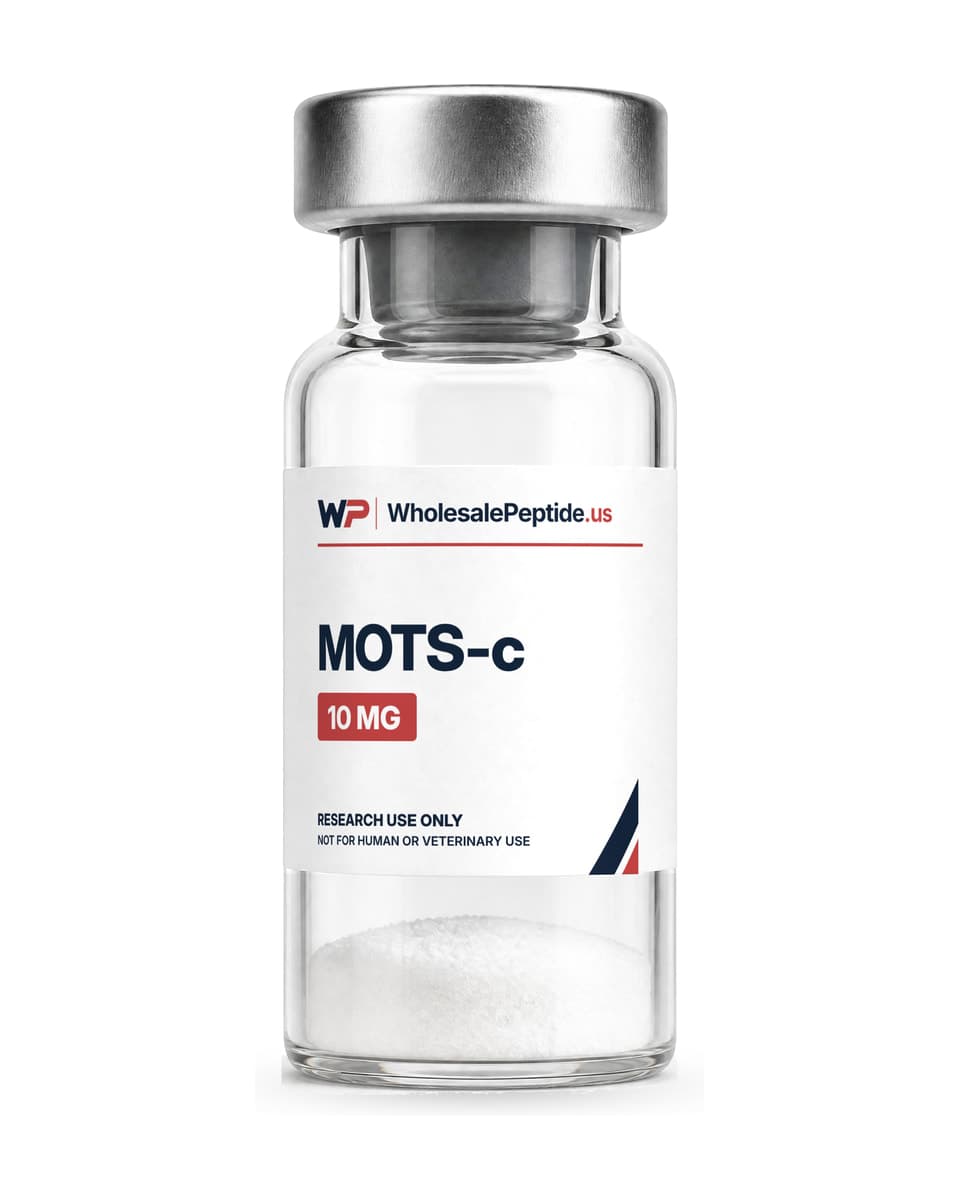
Illustrative product image. The label on each physical vial carries its lot code.
The discount is set by the total kits in your order across all compounds. Per-vial price = kit price ÷ 10.
| SKU | Strength | 1–2 kits | 3–9 kits | 10–49 kits | 50–99 kits | 100+ kits |
|---|---|---|---|---|---|---|
| WP-MOTSC-10 | 10 mg × 10 | $310.00 $31.00 / vial | $294.50 $29.45 / vial | $279.00 $27.90 / vial | $263.50 $26.35 / vial | Quote |
| WP-MOTSC-40 | 40 mg × 10 | $485.00 $48.50 / vial | $460.75 $46.08 / vial | $436.50 $43.65 / vial | $412.25 $41.23 / vial | Quote |
Compare every SKU on the wholesale price list.
Certificate of Analysis — current lot
A lot-specific Certificate of Analysis is published before the lot ships. Lot record and lab report from an independent third-party laboratory will appear here.
Certificate of Analysis — current lot
A lot-specific Certificate of Analysis is published before the lot ships. Lot record and lab report from an independent third-party laboratory will appear here.
All certificates: COA library · how to read a peptide COA · testing and quality · HPLC vs mass spec · storing lyophilized peptides
MOTS-c is a 16-amino-acid peptide encoded by a short open reading frame in the mitochondrial 12S rRNA gene (UniProt A0A0C5B5G6), first described in 2015.
| Class | Mitochondrial-derived peptide (16 residues) |
|---|---|
| CAS number | 1627580-64-6 |
| Molecular formula | C101H152N28O22S2 |
| Molar mass | 2,174.6 g/mol |
| Length | 16 amino acids |
| Sequence | MRWQEMGYIFYPRKLR |
| Registry record | PubChem CID 146675088 |
| U.S. status | Not approved by the FDA |
| Supplied as | 10 mg or 40 mg per vial · 10 vials per kit · lyophilized powder, single compound, single strength · 99%+ purity (RP-HPLC) |
WholesalePeptide.us is a U.S. MOTS-c supplier and vendor for laboratories, distributors and research resellers. Kits ship from Sheridan, WY by UPS / USPS, tracked; orders paid by 2:00 PM ET Monday–Friday leave the same day, typical transit is 1–4 business days, and orders over $500 ship free. Every kit label carries the lot code that matches its certificate from an independent third-party laboratory. For MOTS-c in quantities of 100+ kits, request a bulk quote; for your own label see private label peptides.
MOTS-c — mitochondrial open reading frame of the 12S rRNA type-c — is a 16-residue peptide encoded by a short open reading frame inside the mitochondrial 12S rRNA gene, not in the nuclear genome (UniProt A0A0C5B5G6). It was described in Cell Metabolism in 2015 and belongs to the small group of mitochondrial-derived peptides that also includes humanin and the SHLPs. Its discovery supported the idea that mitochondria signal to the rest of the cell with peptides, not only with metabolites and reactive species.
The sequence is short, unmodified and distinctly hydrophobic for its length, with two methionines, a tryptophan and a C-terminal basic cluster (Arg-Lys-Leu-Arg). That cluster is the part most often implicated in nuclear import, and the two methionines are the main analytical liability, since sulfoxide formation adds +16 Da per residue. Because the peptide is encoded in mitochondrial DNA, it is also read differently from nuclear transcripts — a point that matters when designing expression constructs or interpreting sequence-based searches.
Mechanistically the best-described route is metabolic rather than receptor-mediated. The 2015 work reported that MOTS-c inhibits the folate–methionine pathway and de novo purine biosynthesis, raising AICAR and activating AMP-activated protein kinase, with downstream effects on glucose handling in skeletal-muscle and cell models. A 2018 study in Cell Metabolism showed that under metabolic stress the peptide translocates to the nucleus and associates with antioxidant-response-element regions, influencing stress-response gene expression — the mitochondrial–nuclear communication arm of the literature. A 2021 report in Nature Communications characterized it as an exercise-responsive, mitochondrially encoded regulator of age-dependent physical decline and muscle homeostasis in mice.
As a research tool MOTS-c is used as a stimulus in AMPK phosphorylation and metabolic-flux assays (Seahorse respirometry, glucose-uptake panels in myotubes and adipocytes), in nuclear-translocation and ChIP experiments with labelled or tagged analogs, in rodent exercise and metabolic physiology models, and as an analytical reference standard when circulating MOTS-c is measured by LC-MS or immunoassay in biomarker studies. Human work indexed to date is largely observational biomarker measurement rather than interventional.
Regulatory position, stated factually: MOTS-c is not FDA-approved and is not the active ingredient of any approved product. FDA lists MOTS-c among bulk drug substances whose compounding nominations were withdrawn by the nominators; MOTS-c-related bulk substances were discussed at the Pharmacy Compounding Advisory Committee meeting of July 23–24, 2026, and the HHS interim enforcement-discretion notice published in the Federal Register on October 30, 2026 addresses certain peptide bulk substances in 503A compounding pending rulemaking. That notice is not an approval and is directed at licensed compounders. WholesalePeptide.us supplies MOTS-c as a research reference standard for in-vitro, analytical and preclinical laboratory research.
The sequence contains two methionines, so oxidized species (+16 and +32 Da) are the most common impurities to look for. The lot COA reports both RP-HPLC purity and the LC-MS mass.
U.S. regulatory status of the compound (as an active ingredient): Not approved by the FDA. The material sold here is a research reference chemical, not a drug product.
The CAS number of MOTS-c is 1627580-64-6. Its molecular formula is C101H152N28O22S2 and its average molar mass is about 2,174.6 g/mol. PubChem CID: 146675088.
MOTS-c has an average molar mass of about 2,174.6 g/mol (2,174.6 Da). On a lot COA, LC-MS should report an observed mass that agrees with this within the lab's tolerance.
MOTS-c is a 16-residue peptide. Sequence: MRWQEMGYIFYPRKLR.
Yes. MOTS-c is sold in 10-vial kits with a minimum order of one kit. Published price breaks apply at 3, 10 and 50 kits, and orders of 100+ kits are quoted within one business day. See wholesale pricing. All material is supplied for laboratory research use only.
Every MOTS-c lot is released at 99%+ purity by RP-HPLC, with identity confirmed by LC-MS, tested by an independent third-party laboratory. A lot-specific Certificate of Analysis is published before the lot ships. The lot code on each vial matches its certificate in the COA library.
No. MOTS-c is not an FDA-approved drug and no approved product contains it. Its research base is cell and animal studies plus observational biomarker work. WholesalePeptide.us sells MOTS-c as a research reference material; For laboratory research use only. Not for human or veterinary use.
MOTS-c ships as lyophilized powder in sealed vials via UPS / USPS, tracked. Orders paid by 2:00 PM ET Monday–Friday are dispatched the same day. We ship to U.S. addresses only. Details are on the shipping page.
Because its open reading frame sits inside the mitochondrial 12S rRNA gene rather than in nuclear DNA, so it is studied both as a metabolic signal and as evidence that the mitochondrial genome encodes short regulatory peptides. Laboratories working on either question use the same synthetic reference peptide; identity on each lot COA is confirmed against the 16-residue sequence. For laboratory research use only. Not for human or veterinary use.
Metabolic and mitochondrial peptides
10 mg · 50 mg
Research use only
Metabolic and mitochondrial peptides
600 mg
Research use only
Back to wholesale peptides · full catalog · pricing
For laboratory research use only. Not for human or veterinary use.
For laboratory research use only. Not for human or veterinary use. By continuing you confirm you are buying for laboratory research.