
Most ordered
MOTS-c
Metabolic and mitochondrial peptides
10 mg · 40 mg
From
$31.00 / vial
Research use only
For laboratory research use only. Not for human or veterinary use.
Paid by 2:00 PM ET Monday–Friday ships the same day · Free U.S. shipping over $500
NAD+ (CAS 53-84-9, C21H27N7O14P2, 663.4 g/mol) is supplied by WholesalePeptide.us in 10-vial kits of 500 mg lyophilized powder. Every lot is tested by an independent third-party laboratory (RP-HPLC purity and LC-MS identity); A lot-specific Certificate of Analysis is published before the lot ships. List price for 500 mg is $335.00 per kit ($33.50 per vial), with discounts at 3, 10 and 50 kits and a quote from 100 kits. Minimum order is one kit. Research use only; not for human or veterinary use.
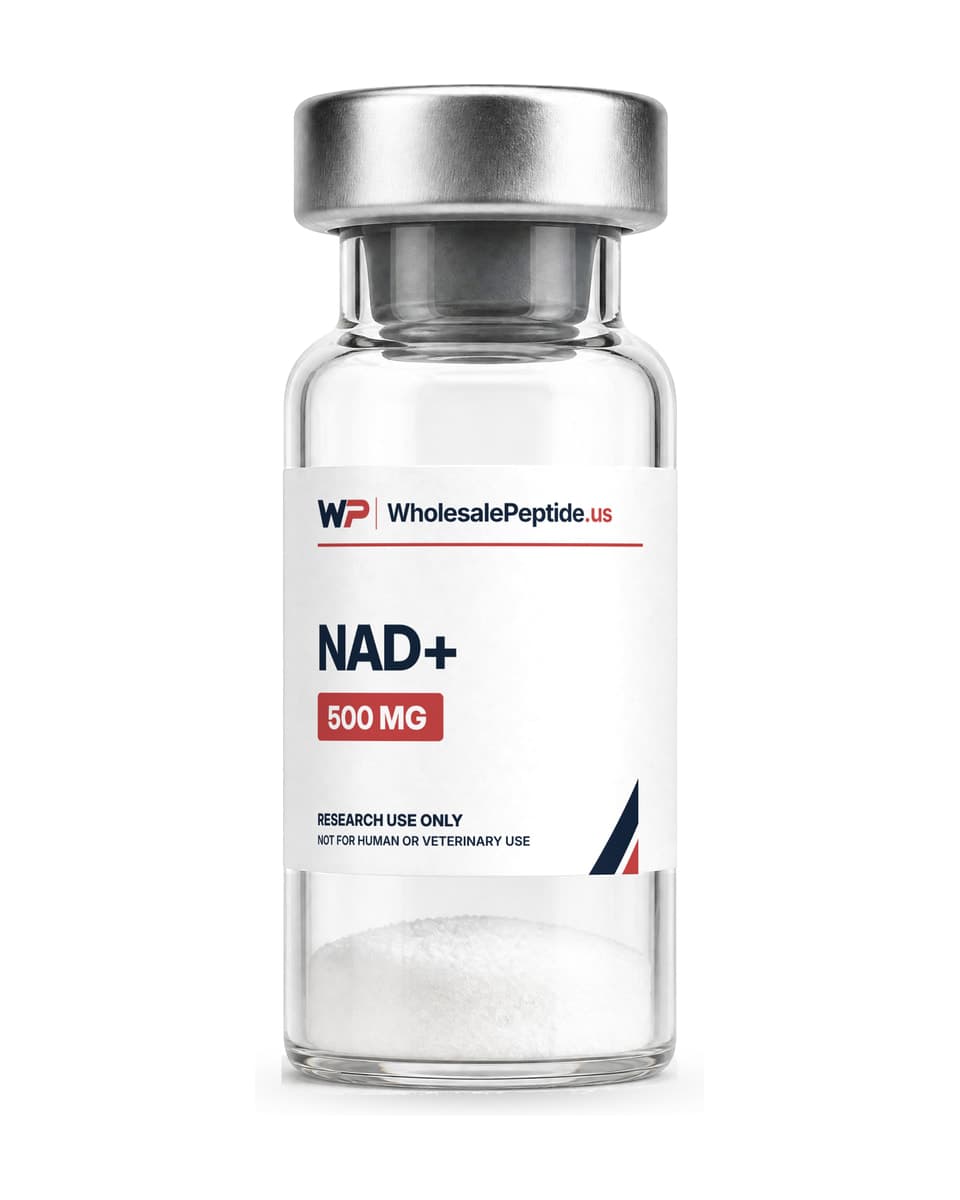
Illustrative product image. The label on each physical vial carries its lot code.
The discount is set by the total kits in your order across all compounds. Per-vial price = kit price ÷ 10.
| SKU | Strength | 1–2 kits | 3–9 kits | 10–49 kits | 50–99 kits | 100+ kits |
|---|---|---|---|---|---|---|
| WP-NAD-500 | 500 mg × 10 | $335.00 $33.50 / vial | $318.25 $31.83 / vial | $301.50 $30.15 / vial | $284.75 $28.48 / vial | Quote |
Compare every SKU on the wholesale price list.
Certificate of Analysis — current lot
A lot-specific Certificate of Analysis is published before the lot ships. Lot record and lab report from an independent third-party laboratory will appear here.
All certificates: COA library · how to read a peptide COA · testing and quality · HPLC vs mass spec · storing lyophilized peptides
NAD+ (β-nicotinamide adenine dinucleotide, oxidized form) is a dinucleotide coenzyme of a nicotinamide mononucleotide joined to an adenine mononucleotide through a pyrophosphate bridge; it is a small-molecule cofactor, not a peptide.
| Also known as | β-NAD+, nadide, nicotinamide adenine dinucleotide |
|---|---|
| Class | Dinucleotide coenzyme (not a peptide) |
| CAS number | 53-84-9 |
| Molecular formula | C21H27N7O14P2 |
| Molar mass | 663.4 g/mol |
| Structure | β-Nicotinamide adenine dinucleotide, oxidized form: nicotinamide riboside and adenosine joined through a pyrophosphate bridge. A coenzyme, not a peptide. |
| Registry record | PubChem CID 5892 |
| Supplied as | 500 mg per vial · 10 vials per kit · lyophilized powder, single compound, single strength · 99%+ purity (RP-HPLC) |
WholesalePeptide.us is a U.S. NAD+ supplier and vendor for laboratories, distributors and research resellers. Kits ship from Sheridan, WY by UPS / USPS, tracked; orders paid by 2:00 PM ET Monday–Friday leave the same day, typical transit is 1–4 business days, and orders over $500 ship free. Every kit label carries the lot code that matches its certificate from an independent third-party laboratory. For NAD+ in quantities of 100+ kits, request a bulk quote; for your own label see private label peptides.
β-Nicotinamide adenine dinucleotide, NAD+, is a coenzyme rather than a peptide, and it is stocked here alongside the peptide catalog because it is a routine reagent in the same metabolic and mitochondrial research. Structurally it is a dinucleotide: a nicotinamide ribonucleotide and an adenine ribonucleotide linked through a pyrophosphate bridge. NAD+ is the oxidized form; accepting a hydride at the nicotinamide ring gives the reduced form, NADH. That reversible interconversion between NAD+ and NADH is the basis of its first role, as the electron-carrying cofactor for the oxidoreductases of central metabolism.
In the laboratory the oxidized/reduced pair is the foundation of dehydrogenase enzyme assays. Because NADH absorbs strongly at 340 nm and NAD+ does not, the appearance or disappearance of NADH gives a direct spectrophotometric readout of enzyme activity, and coupled assays built on that signal are used to follow a very wide range of reactions. Supplying NAD+ as a defined reference reagent is what lets those assays be quantified against a known cofactor concentration, and the NAD+/NADH ratio itself is a commonly measured index of a sample's metabolic and redox state.
The second role is as a consumed substrate for non-redox, NAD+-dependent enzymes, and this is where most current interest sits. The sirtuins are NAD+-dependent protein deacetylases: the 2000 Nature report from Imai, Armstrong, Kaeberlein and Guarente that yeast and mouse Sir2 are NAD-dependent histone deacetylases is the work that connected the coenzyme to chromatin and to the biology of aging. The poly(ADP-ribose) polymerases, PARPs, consume NAD+ to build ADP-ribose polymers in DNA-damage signaling, and the ectoenzyme CD38 degrades it. Each of these makes NAD+ a required substrate in its in-vitro assay, so defined NAD+ is used both as the cofactor and as the thing whose consumption is measured.
Those two roles converge on mitochondrial and metabolic research. Reviews by Cantó, Menzies and Auwerx in 2015 and by Covarrubias and colleagues with Verdin in 2021 describe how NAD+ availability couples cellular energy status to sirtuin activity, mitochondrial function and the broader set of pathways the coenzyme touches, and a 2015 Science overview by Verdin set out its place in metabolism and neurodegeneration. For a bench scientist this means NAD+ turns up in assays of mitochondrial dehydrogenases, in sirtuin and PARP activity measurements, and in extracts where the NAD+/NADH ratio is read out — settings for which accurate quantification of the coenzyme is essential. Yoshino and Imai's 2013 reverse-phase HPLC method for measuring NAD+ in cells and tissues is a standard reference for that quantification.
This item is supplied as 500 mg of lyophilized NAD+ per vial. Regulatory position, stated factually: NAD+ is an endogenous coenzyme and a standard biochemical reagent; the material sold here is a research reference standard and is not offered as, or as a component of, any approved product. WholesalePeptide.us supplies it for laboratory research only.
Practical note for assay design: NAD+ is hygroscopic and hydrolyzes slowly in aqueous solution, faster under alkaline conditions and warmth, so stocks are made fresh, kept cold, and often held slightly acidic. Because it is not a peptide, its identity is confirmed on each lot COA by mass and purity against the dinucleotide structure, and net content governs how much cofactor is actually delivered into an assay.
The CAS number of NAD+ is 53-84-9. Its molecular formula is C21H27N7O14P2 and its average molar mass is about 663.4 g/mol. PubChem CID: 5892.
NAD+ has an average molar mass of about 663.4 g/mol (663.4 Da). On a lot COA, LC-MS should report an observed mass that agrees with this within the lab's tolerance.
Yes. NAD+ is sold in 10-vial kits with a minimum order of one kit. Published price breaks apply at 3, 10 and 50 kits, and orders of 100+ kits are quoted within one business day. See wholesale pricing. All material is supplied for laboratory research use only.
Every NAD+ lot is released at 99%+ purity by RP-HPLC, with identity confirmed by LC-MS, tested by an independent third-party laboratory. A lot-specific Certificate of Analysis is published before the lot ships. Each vial contains 500 mg of lyophilized β-nicotinamide adenine dinucleotide, and the lot code matches its certificate in the COA library.
No. NAD+ is a dinucleotide coenzyme, not a peptide. It is stocked alongside the peptide catalog because it is a common reagent in the same metabolic and mitochondrial research — sirtuin, PARP and dehydrogenase assays, and NAD+/NADH ratio work. WholesalePeptide.us supplies it as a research reference material only; For laboratory research use only. Not for human or veterinary use.
NAD+ ships as lyophilized powder in sealed vials via UPS / USPS, tracked. Orders paid by 2:00 PM ET Monday–Friday are dispatched the same day. We ship to U.S. addresses only. Details are on the shipping page.
NAD+ is the oxidized form and NADH the reduced form of the same coenzyme. NADH absorbs at 340 nm and NAD+ does not, so dehydrogenase assays follow the conversion between them optically. Sirtuins and PARPs instead consume NAD+ as a substrate. This item is the oxidized form, NAD+, and its mass on each lot COA confirms that identity. For laboratory research use only. Not for human or veterinary use.
Metabolic and mitochondrial peptides
10 mg · 40 mg
Research use only
Metabolic and mitochondrial peptides
10 mg · 50 mg
Research use only
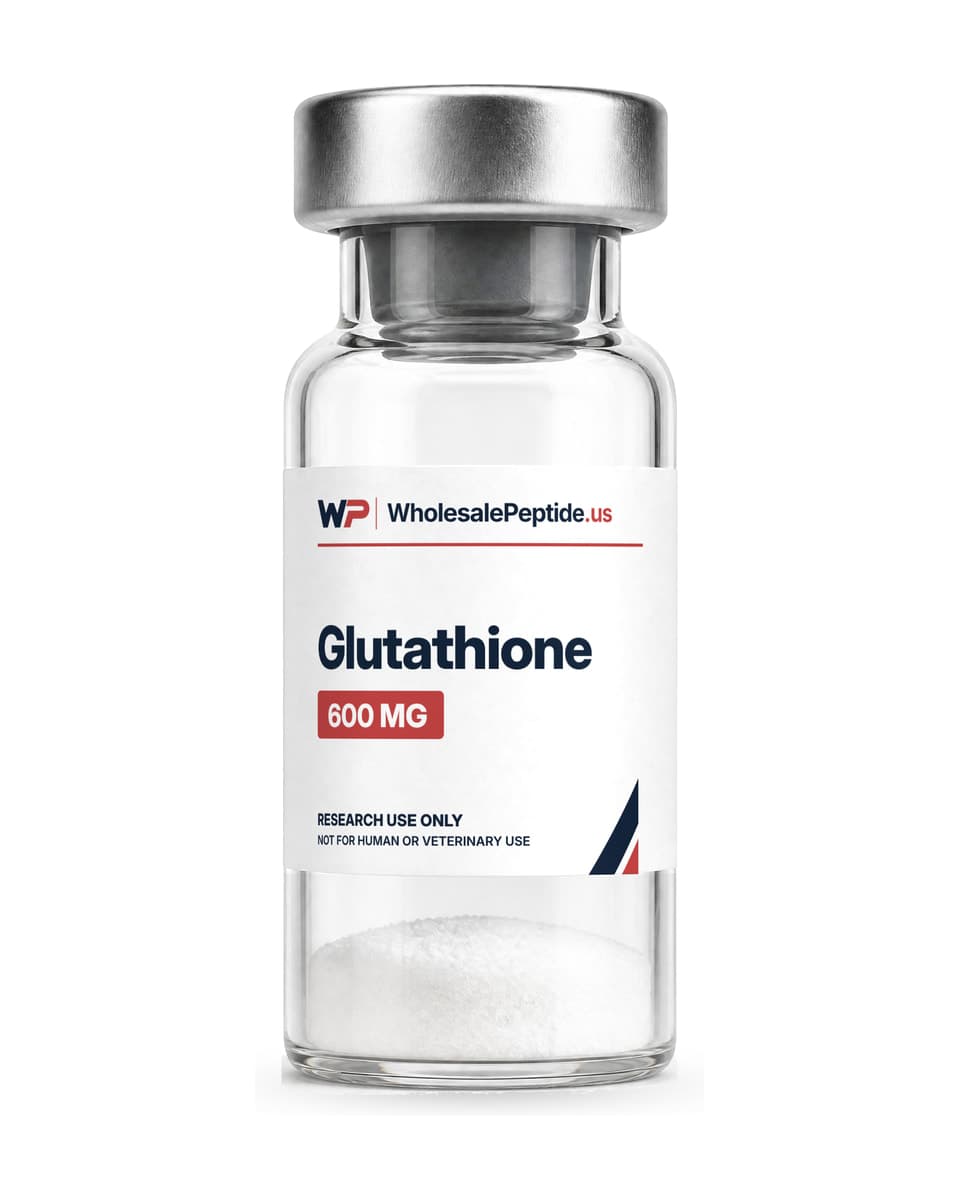
Metabolic and mitochondrial peptides
600 mg
Research use only
Back to wholesale peptides · full catalog · pricing
For laboratory research use only. Not for human or veterinary use.
For laboratory research use only. Not for human or veterinary use. By continuing you confirm you are buying for laboratory research.