
Backorder
BPC-157
Tissue-repair research peptides
5 mg · 10 mg
From
$27.00 / vial
Research use only
For laboratory research use only. Not for human or veterinary use.
Paid by 2:00 PM ET Monday–Friday ships the same day · Free U.S. shipping over $500
GHK-Cu (CAS 89030-95-5, C14H23CuN6O4+, 402.9 g/mol) is supplied by WholesalePeptide.us in 10-vial kits of 50 or 100 mg lyophilized powder. Every lot is tested by an independent third-party laboratory (RP-HPLC purity and LC-MS identity); A lot-specific Certificate of Analysis is published before the lot ships. List price for 50 mg is $250.00 per kit ($25.00 per vial), with discounts at 3, 10 and 50 kits and a quote from 100 kits. Minimum order is one kit. Research use only; not for human or veterinary use.
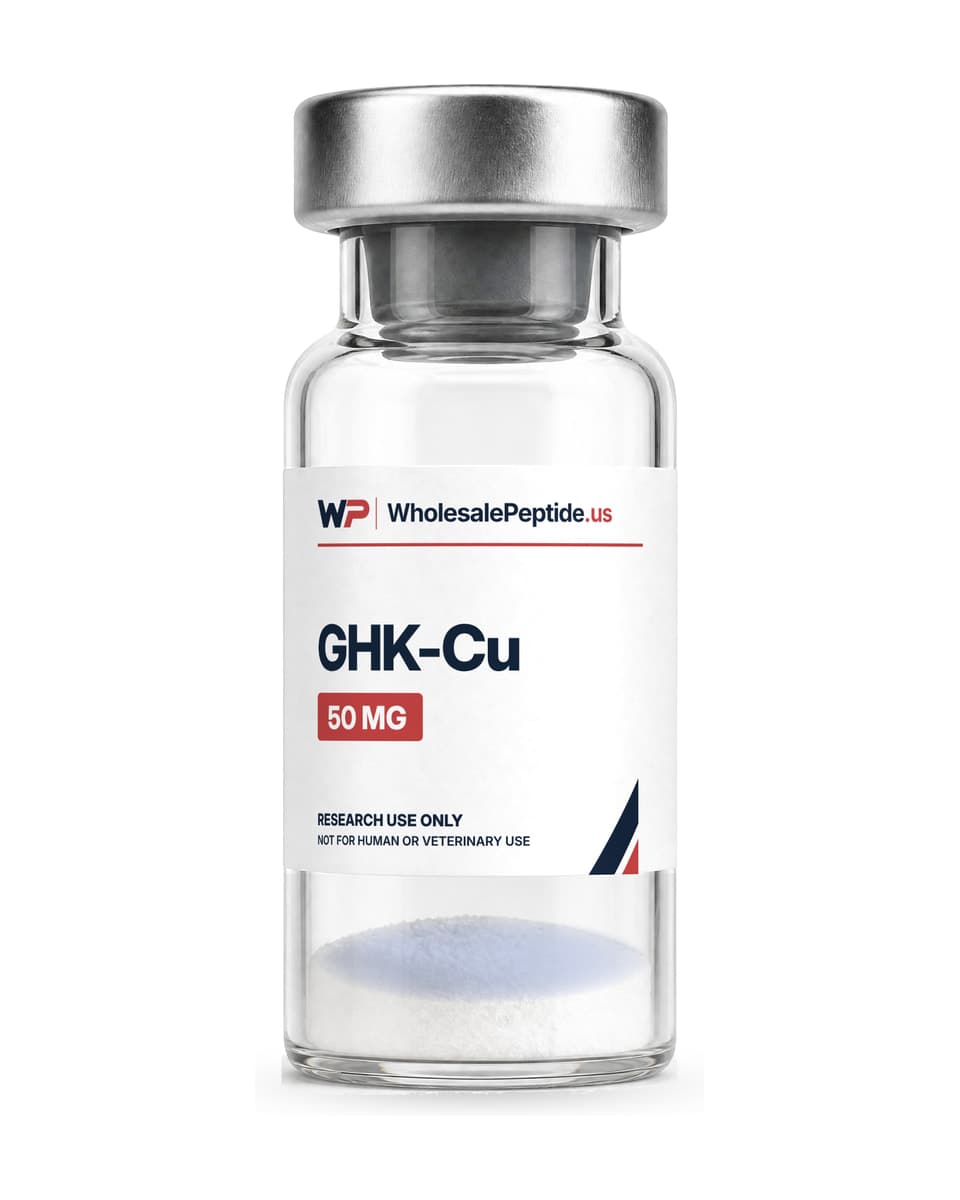
Illustrative product image. The label on each physical vial carries its lot code.
The discount is set by the total kits in your order across all compounds. Per-vial price = kit price ÷ 10.
| SKU | Strength | 1–2 kits | 3–9 kits | 10–49 kits | 50–99 kits | 100+ kits |
|---|---|---|---|---|---|---|
| WP-GHKCU-50Backorder | 50 mg × 10 | $250.00 $25.00 / vial | $237.50 $23.75 / vial | $225.00 $22.50 / vial | $212.50 $21.25 / vial | Quote |
| WP-GHKCU-100 | 100 mg × 10 | $250.00 $25.00 / vial | $237.50 $23.75 / vial | $225.00 $22.50 / vial | $212.50 $21.25 / vial | Quote |
Compare every SKU on the wholesale price list.
Certificate of Analysis — current lot
A lot-specific Certificate of Analysis is published before the lot ships. Lot record and lab report from an independent third-party laboratory will appear here.
Certificate of Analysis — current lot
A lot-specific Certificate of Analysis is published before the lot ships. Lot record and lab report from an independent third-party laboratory will appear here.
All certificates: COA library · how to read a peptide COA · testing and quality · HPLC vs mass spec · storing lyophilized peptides
GHK-Cu is the copper(II) complex of the naturally occurring tripeptide glycyl-L-histidyl-L-lysine (GHK), also listed as copper tripeptide-1.
| Also known as | copper tripeptide-1, prezatide copper |
|---|---|
| Class | Copper-binding tripeptide |
| CAS number | 89030-95-5 |
| Molecular formula | C14H23CuN6O4+ |
| Molar mass | 402.92 g/mol |
| Length | 3 amino acids |
| Sequence | Gly-His-Lys · Cu(II) |
| Registry record | PubChem CID 71587328 |
| U.S. status | Not FDA-approved |
| Supplied as | 50 mg or 100 mg per vial · 10 vials per kit · lyophilized powder, single compound, single strength · 99%+ purity (RP-HPLC) |
WholesalePeptide.us is a U.S. GHK-Cu supplier and vendor for laboratories, distributors and research resellers. Kits ship from Sheridan, WY by UPS / USPS, tracked; orders paid by 2:00 PM ET Monday–Friday leave the same day, typical transit is 1–4 business days, and orders over $500 ship free. Every kit label carries the lot code that matches its certificate from an independent third-party laboratory. For GHK-Cu in quantities of 100+ kits, request a bulk quote; for your own label see private label peptides.
GHK is a tripeptide first described by Loren Pickart in 1973 as a factor in human serum that prolonged the survival of normal liver cells in culture, and later shown to act by facilitating copper uptake into cells (Pickart et al., Nature, 1980). It binds copper(II) with high affinity through the histidine imidazole, the glycine amino group and a backbone amide, forming the blue GHK-Cu complex that is the form most research uses. Under the cosmetic ingredient name copper tripeptide-1 it is also a familiar topical formulation ingredient.
Coordination chemistry. The structure of the complex has been determined in the solid state and in solution alongside the related plasma chelator DAHK. In the solid state [Cu(II)(GHK)] is dimeric; in solution it is monomeric, with three nitrogen donors (the terminal amine, an amide nitrogen and the imidazole) and a labile fourth equatorial position that can be occupied by a carboxylate or by an exogenous ligand such as glycine or histidine in ternary complexes. Cyclic voltammetry and ascorbate-oxidation measurements show the Cu(II) complex is redox-inert at moderate potentials, but unlike DAHK it can be reduced to Cu(I) at about −0.62 V, after which the copper ion is released, and copper exchange between GHK molecules is fast (Hureau et al., Chemistry – A European Journal, 2011). Those properties matter in practice: the labile fourth site and fast exchange are why buffer composition and competing chelators change what species is actually present in an assay.
Research on GHK-Cu spans three areas: connective-tissue remodeling (collagen and glycosaminoglycan synthesis by fibroblasts in culture and in rodent wound-closure models), copper transport and delivery to cells, and gene-expression studies. The gene-expression line has a specific origin: a Boston University group profiling lung tissue by regional emphysema severity identified 127 severity-associated genes, then queried the Connectivity Map for compounds that would reverse that signature and retrieved GHK. In follow-up experiments GHK reproduced TGF-β-induced expression patterns in human fibroblasts, organized the actin cytoskeleton, raised integrin β1 expression, and restored collagen-I contraction and remodeling by fibroblasts from diseased lungs (Campbell et al., Genome Medicine, 2012). Rodent models of acute lung injury and of ligament-graft repair have also been used to study its signaling.
As a laboratory tool, GHK-Cu is therefore used in three distinct assay families: fibroblast culture work read out by collagen and extracellular-matrix synthesis, contraction and gene expression; copper-coordination chemistry measured by spectroscopy, EPR and electrochemistry; and transcriptome-level profiling where the point of interest is the breadth of the expression shift rather than a single pathway. Because the copper is integral to the complex, assay buffers matter more than for an ordinary peptide.
U.S. regulatory status: GHK-Cu is not an FDA-approved drug; topical cosmetic use of copper tripeptide-1 is regulated separately as a cosmetic ingredient. For parenteral routes, GHK-Cu appears in FDA's compounding records among nominated bulk drug substances with identified potential significant safety risks, with the agency citing immunogenicity risk from aggregation and peptide-related impurities and limited human data. WholesalePeptide.us supplies it only for in-vitro, analytical and preclinical laboratory research.
Because the copper is part of the complex, the free-peptide mass of GHK and the mass of GHK-Cu differ; the COA states which species the LC-MS identity result refers to.
Lab teams frequently order GHK-Cu alongside BPC-157 and TB-500 for comparative studies in fibroblast and dermal models, and the three are also stocked together as the GLOW blend. Mixed-compound orders count toward the same wholesale tier, and every lot ships with a COA published before the lot leaves the warehouse.
U.S. regulatory status of the compound (as an active ingredient): Not FDA-approved. The material sold here is a research reference chemical, not a drug product.
The CAS number of GHK-Cu is 89030-95-5. Its molecular formula is C14H23CuN6O4+ and its average molar mass is about 402.9 g/mol. PubChem CID: 71587328.
GHK-Cu has an average molar mass of about 402.9 g/mol (402.9 Da). On a lot COA, LC-MS should report an observed mass that agrees with this within the lab's tolerance.
GHK-Cu is a 3-residue peptide. Sequence: Gly-His-Lys · Cu(II).
Yes. WholesalePeptide.us sells GHK-Cu from one kit upward in 10-vial kits. Published discounts start at 3, 10 and 50 kits, and orders of 100+ kits are quoted. It is also stocked in the GLOW blend with BPC-157 and TB-500. Research use only.
GHK-Cu lots ship at 99%+ purity by RP-HPLC with identity confirmed by LC-MS. Each lot is tested by an independent third-party laboratory. A lot-specific Certificate of Analysis is published before the lot ships. The COA states whether the mass result refers to free GHK or the copper complex.
No. GHK-Cu is not an FDA-approved drug for systemic use. WholesalePeptide.us sells it as a research compound for laboratory research use only, not for human or veterinary use.
Yes. Published coordination chemistry shows the Cu(II) complex has one labile equatorial site and exchanges copper quickly, and that reduction to Cu(I) releases the copper ion. Strong chelators such as EDTA, or reducing agents, can therefore change which species is present. The complex is blue, so a colour change in solution is a visible warning of copper loss or contamination.
GHK-Cu ships as lyophilized powder in sealed vials via UPS / USPS, tracked. Orders paid by 2:00 PM ET Monday–Friday leave the same day from Sheridan, WY. U.S. destinations only.
Tissue-repair research peptides
5 mg · 10 mg
Research use only
Tissue-repair research peptides
5 mg · 10 mg
Research use only
Back to wholesale peptides · full catalog · pricing
For laboratory research use only. Not for human or veterinary use.
For laboratory research use only. Not for human or veterinary use. By continuing you confirm you are buying for laboratory research.