
Most ordered
MOTS-c
Metabolic and mitochondrial peptides
10 mg · 40 mg
From
$31.00 / vial
Research use only
For laboratory research use only. Not for human or veterinary use.
Paid by 2:00 PM ET Monday–Friday ships the same day · Free U.S. shipping over $500
AOD-9604 (CAS 221231-10-3, C78H123N23O23S2, 1,815.1 g/mol) is supplied by WholesalePeptide.us in 10-vial kits of 5 mg lyophilized powder. Every lot is tested by an independent third-party laboratory (RP-HPLC purity and LC-MS identity); A lot-specific Certificate of Analysis is published before the lot ships. List price for 5 mg is $290.00 per kit ($29.00 per vial), with discounts at 3, 10 and 50 kits and a quote from 100 kits. Minimum order is one kit. Research use only; not for human or veterinary use.
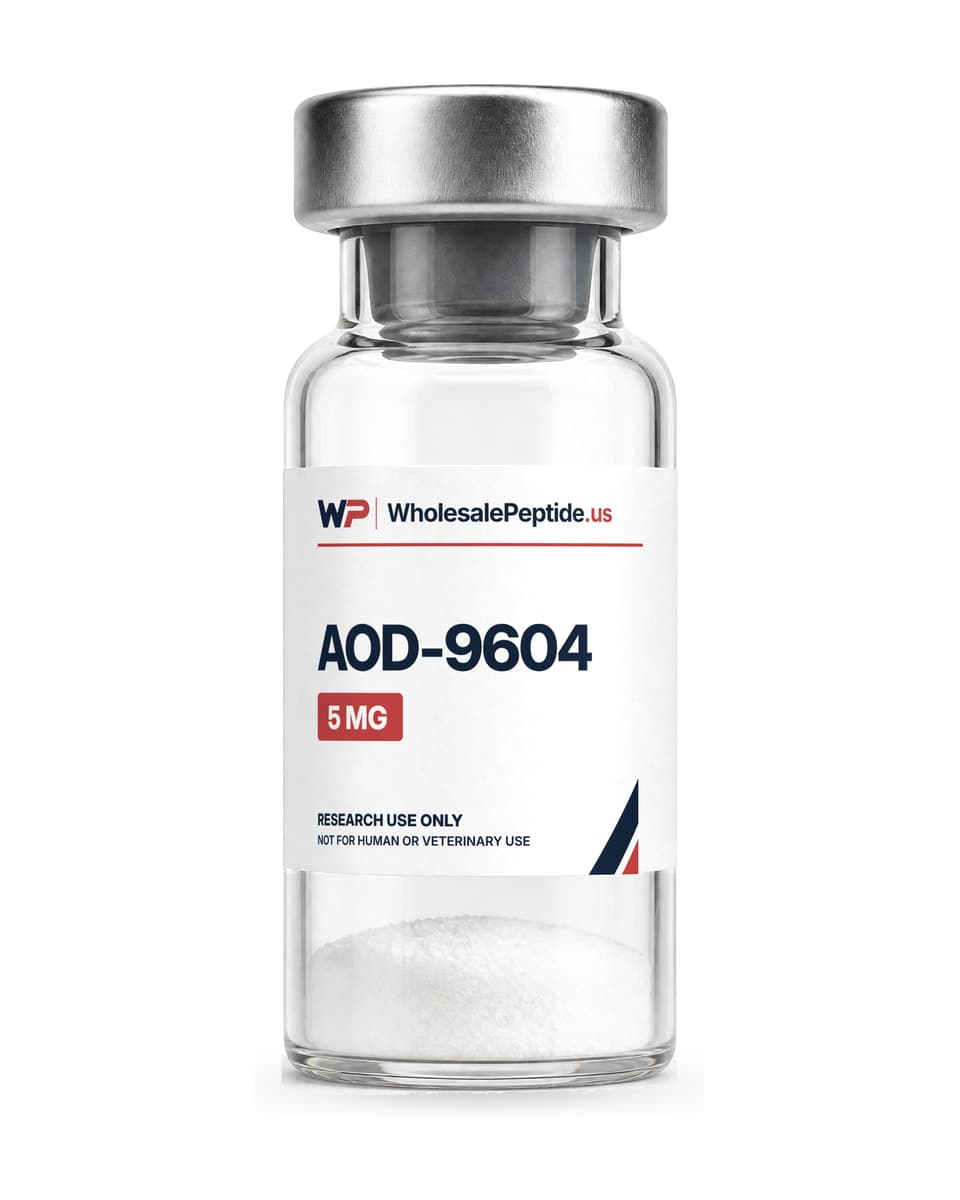
Illustrative product image. The label on each physical vial carries its lot code.
The discount is set by the total kits in your order across all compounds. Per-vial price = kit price ÷ 10.
| SKU | Strength | 1–2 kits | 3–9 kits | 10–49 kits | 50–99 kits | 100+ kits |
|---|---|---|---|---|---|---|
| WP-AOD-5 | 5 mg × 10 | $290.00 $29.00 / vial | $275.50 $27.55 / vial | $261.00 $26.10 / vial | $246.50 $24.65 / vial | Quote |
Compare every SKU on the wholesale price list.
Certificate of Analysis — current lot
A lot-specific Certificate of Analysis is published before the lot ships. Lot record and lab report from an independent third-party laboratory will appear here.
All certificates: COA library · how to read a peptide COA · testing and quality · HPLC vs mass spec · storing lyophilized peptides
AOD-9604 is a synthetic 16-residue peptide based on the C-terminal region (residues 177–191) of human growth hormone, with an added N-terminal tyrosine and a disulfide bridge.
| Also known as | hGH fragment 176-191, LAT-8881 |
|---|---|
| Class | Modified hGH C-terminal fragment (Tyr-hGH 177-191) |
| CAS number | 221231-10-3 |
| Molecular formula | C78H123N23O23S2 |
| Molar mass | 1,815.1 g/mol |
| Length | 16 amino acids |
| Sequence | YLRIVQCRSVEGSCGF |
| Structure | Tyr-hGH(177-191): human growth hormone fragment 177-191 with an added N-terminal tyrosine; Cys7–Cys14 disulfide. |
| FDA UNII | 7UP768IP4M (FDA GSRS) |
| Registry record | PubChem CID 71300630 |
| U.S. status | Not approved by the FDA |
| Supplied as | 5 mg per vial · 10 vials per kit · lyophilized powder, single compound, single strength · 99%+ purity (RP-HPLC) |
WholesalePeptide.us is a U.S. AOD-9604 supplier and vendor for laboratories, distributors and research resellers. Kits ship from Sheridan, WY by UPS / USPS, tracked; orders paid by 2:00 PM ET Monday–Friday leave the same day, typical transit is 1–4 business days, and orders over $500 ship free. Every kit label carries the lot code that matches its certificate from an independent third-party laboratory. For AOD-9604 in quantities of 100+ kits, request a bulk quote; for your own label see private label peptides.
AOD-9604 came out of structure–activity work at Monash University on the C-terminal end of human growth hormone and was developed by Metabolic Pharmaceuticals in Australia; the designation stands for "Advanced Obesity Drug". It is also indexed as LAT-8881. The parent fragment, hGH(176–191), had been reported to retain the hormone's lipolytic activity in rodent adipose tissue without its growth-promoting or insulin-like activity, and AOD-9604 is the stabilized analog of that region.
The modification is precise and worth getting right on a label: AOD-9604 is hGH(177–191) carrying an added N-terminal tyrosine, so the tyrosine occupies the position of the phenylalanine that begins the 176–191 fragment. The internal cysteines at the positions corresponding to hGH Cys182 and Cys189 form a disulfide, which closes the loop that gives the fragment its shape; reduction of that bond is one of the common lot-to-lot identity problems. The result is a 16-residue peptide that is often mislabelled in the trade as plain "fragment 176–191", which is a different molecule with a different mass.
At the cellular level the reported pharmacology is receptor-independent in an important sense. A 2001 study in the International Journal of Obesity reported that AOD-9604 did not compete with radiolabelled hGH for the growth hormone receptor in transfected BaF-B03 cells and did not induce proliferation in that system, while still increasing fat oxidation and plasma glycerol in obese and lean mice. A companion study in Endocrinology the same year used beta-3-adrenergic-receptor knock-out mice and found that chronic exposure failed to reproduce the body-composition and lipolysis changes seen in wild-type animals, although both hGH and AOD-9604 raised beta-3-AR transcript levels; the authors concluded the lipolytic action is not mediated directly through beta-3-AR but may act through increased receptor expression. Earlier work in obese Zucker rats, published in Hormone Research, characterized increased lipolytic activity in adipose tissue without the insulin-sensitivity changes seen with intact hGH under euglycaemic-clamp conditions.
For laboratories the compound is used as a reference lipolytic fragment: glycerol and non-esterified-fatty-acid release from isolated adipocytes or explants, lipogenesis assays, beta-adrenergic transcript and cAMP readouts, hGH-receptor binding and proliferation assays as a negative-control ligand, and LC-MS identity work where distinguishing the tyrosine-extended analog from the bare fragment is the whole exercise.
Regulatory position, stated factually: AOD-9604 is not FDA-approved, has never been marketed as a drug, and is not the active ingredient of any approved U.S. product. FDA lists AOD-9604 among bulk drug substances that were nominated for use in compounding and then withdrawn by the nominators. WholesalePeptide.us supplies AOD-9604 as a research reference standard for in-vitro, analytical and preclinical laboratory research.
Suppliers use "AOD-9604" and "fragment 176–191" loosely. The two differ by the extra tyrosine and therefore by mass. The LC-MS identity line on each lot COA states which molecule is in the vial, and the disulfide should be reported as intact.
U.S. regulatory status of the compound (as an active ingredient): Not approved by the FDA. The material sold here is a research reference chemical, not a drug product.
The CAS number of AOD-9604 is 221231-10-3. Its molecular formula is C78H123N23O23S2 and its average molar mass is about 1,815.1 g/mol. FDA UNII: 7UP768IP4M. PubChem CID: 71300630.
AOD-9604 has an average molar mass of about 1,815.1 g/mol (1,815.1 Da). On a lot COA, LC-MS should report an observed mass that agrees with this within the lab's tolerance.
AOD-9604 is a 16-residue peptide. Sequence: YLRIVQCRSVEGSCGF. Tyr-hGH(177-191): human growth hormone fragment 177-191 with an added N-terminal tyrosine; Cys7–Cys14 disulfide.
Yes. AOD-9604 is sold in 10-vial kits with a minimum order of one kit. Published price breaks apply at 3, 10 and 50 kits, and orders of 100+ kits are quoted within one business day. See wholesale pricing. All material is supplied for laboratory research use only.
Every AOD-9604 lot is released at 99%+ purity by RP-HPLC, with identity confirmed by LC-MS, tested by an independent third-party laboratory. A lot-specific Certificate of Analysis is published before the lot ships. The lot code on each vial matches its certificate in the COA library.
No. AOD-9604 is not an FDA-approved drug and no approved U.S. product contains it. WholesalePeptide.us sells AOD-9604 strictly as a research reference material for laboratory work; For laboratory research use only. Not for human or veterinary use.
AOD-9604 ships as lyophilized powder in sealed vials via UPS / USPS, tracked. Orders paid by 2:00 PM ET Monday–Friday are dispatched the same day. We ship to U.S. addresses only. Details are on the shipping page.
Published cell work says no: in receptor-transfected cells it did not compete with radiolabelled hGH for binding and did not drive proliferation, which is why it is used in the literature as a GH-receptor-independent lipolytic fragment and as a negative-control ligand in binding assays. WholesalePeptide.us supplies it for that kind of laboratory work only; For laboratory research use only. Not for human or veterinary use.
Metabolic and mitochondrial peptides
10 mg · 40 mg
Research use only
Metabolic and mitochondrial peptides
10 mg · 50 mg
Research use only
Metabolic and mitochondrial peptides
600 mg
Research use only
Back to wholesale peptides · full catalog · pricing
For laboratory research use only. Not for human or veterinary use.
For laboratory research use only. Not for human or veterinary use. By continuing you confirm you are buying for laboratory research.