
Most ordered
MOTS-c
Metabolic and mitochondrial peptides
10 mg · 40 mg
From
$31.00 / vial
Research use only
For laboratory research use only. Not for human or veterinary use.
Paid by 2:00 PM ET Monday–Friday ships the same day · Free U.S. shipping over $500
Glutathione (GSH) (CAS 70-18-8, C10H17N3O6S, 307.3 g/mol) is supplied by WholesalePeptide.us in 10-vial kits of 600 mg lyophilized powder. Every lot is tested by an independent third-party laboratory (RP-HPLC purity and LC-MS identity); A lot-specific Certificate of Analysis is published before the lot ships. List price for 600 mg is $300.00 per kit ($30.00 per vial), with discounts at 3, 10 and 50 kits and a quote from 100 kits. Minimum order is one kit. Research use only; not for human or veterinary use.
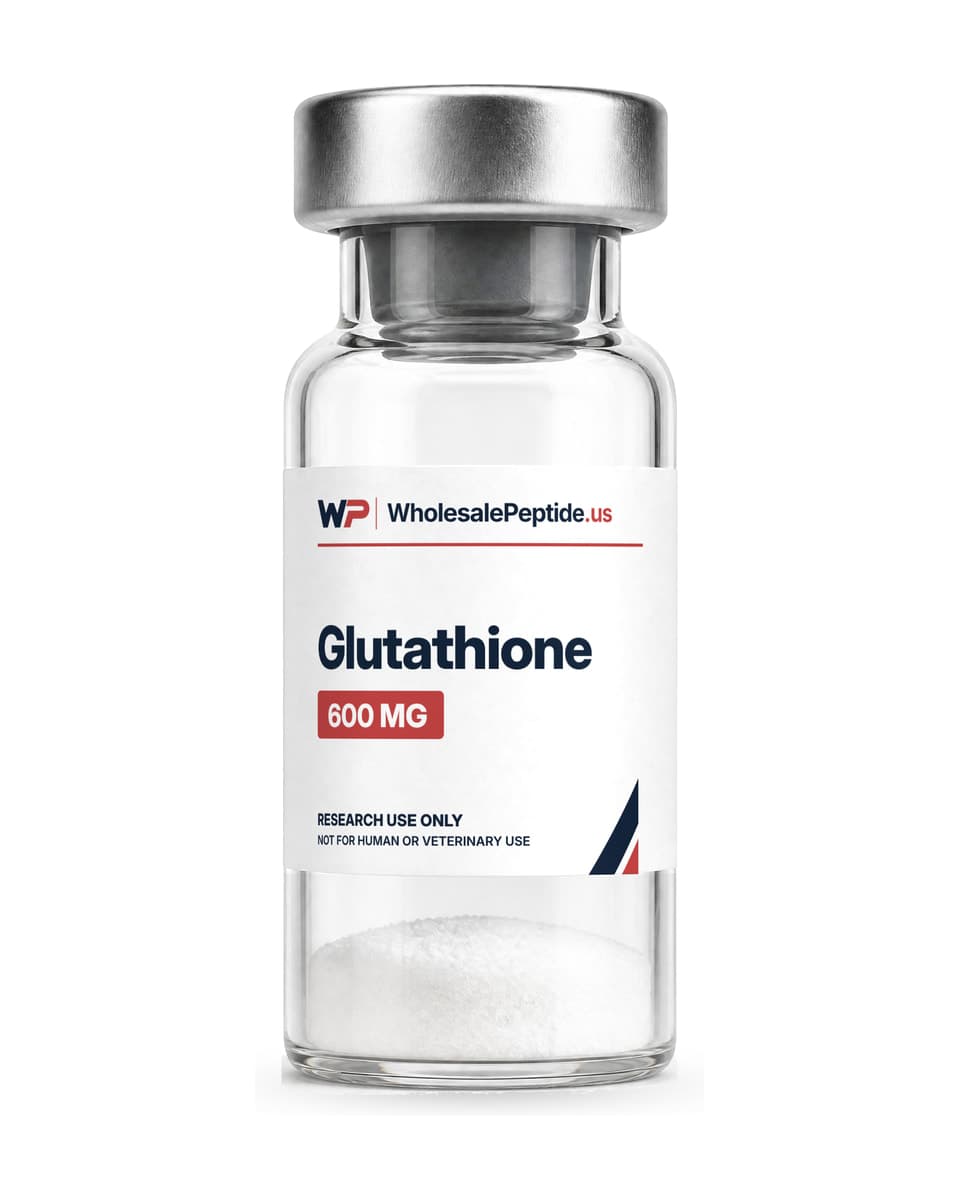
Illustrative product image. The label on each physical vial carries its lot code.
The discount is set by the total kits in your order across all compounds. Per-vial price = kit price ÷ 10.
| SKU | Strength | 1–2 kits | 3–9 kits | 10–49 kits | 50–99 kits | 100+ kits |
|---|---|---|---|---|---|---|
| WP-GSH-600 | 600 mg × 10 | $300.00 $30.00 / vial | $285.00 $28.50 / vial | $270.00 $27.00 / vial | $255.00 $25.50 / vial | Quote |
Compare every SKU on the wholesale price list.
Certificate of Analysis — current lot
A lot-specific Certificate of Analysis is published before the lot ships. Lot record and lab report from an independent third-party laboratory will appear here.
All certificates: COA library · how to read a peptide COA · testing and quality · HPLC vs mass spec · storing lyophilized peptides
Glutathione is the tripeptide γ-L-glutamyl-L-cysteinyl-glycine (reduced form, GSH), the most abundant low-molecular-weight thiol in most living cells.
| Also known as | GSH, L-glutathione reduced, γ-L-glutamyl-L-cysteinylglycine |
|---|---|
| Class | Tripeptide thiol (γ-Glu-Cys-Gly) |
| CAS number | 70-18-8 |
| Molecular formula | C10H17N3O6S |
| Molar mass | 307.33 g/mol |
| Length | 3 amino acids |
| Sequence | γ-Glu-Cys-Gly |
| Structure | Reduced glutathione (GSH): γ-glutamyl peptide bond between the Glu side-chain carboxyl and Cys; free Cys thiol. Oxidizes to the disulfide GSSG. |
| Registry record | PubChem CID 124886 |
| Supplied as | 600 mg per vial · 10 vials per kit · lyophilized powder, single compound, single strength · 99%+ purity (RP-HPLC) |
WholesalePeptide.us is a U.S. Glutathione supplier and vendor for laboratories, distributors and research resellers. Kits ship from Sheridan, WY by UPS / USPS, tracked; orders paid by 2:00 PM ET Monday–Friday leave the same day, typical transit is 1–4 business days, and orders over $500 ship free. Every kit label carries the lot code that matches its certificate from an independent third-party laboratory. For Glutathione in quantities of 100+ kits, request a bulk quote; for your own label see private label peptides.
Glutathione is a tripeptide of glutamate, cysteine and glycine, and the single most abundant low-molecular-weight thiol in most cells. Its defining structural feature is that the first peptide bond is not a normal α-amide: the glutamate is joined to cysteine through its γ-carboxyl, making a γ-glutamyl isopeptide linkage that ordinary peptidases cannot cleave and that only γ-glutamyl transpeptidase acts on. The reduced form, GSH, carries a free sulfhydryl on the cysteine; two molecules joined through a disulfide give the oxidized form, GSSG. The chemistry of that thiol is the whole reason the molecule is studied. The classic reference account is Meister and Anderson's 1983 Annual Review of Biochemistry article, which laid out its synthesis, turnover and redox role.
In redox biology GSH is the cell's main small-molecule reductant. The ratio of reduced to oxidized glutathione, GSH/GSSG, is the standard index of a sample's redox poise, and measuring it accurately is a recurring bench problem because GSH oxidizes readily once a sample is disturbed. The workhorse method is the enzymatic recycling assay: 5,5′-dithiobis(2-nitrobenzoic acid), Ellman's reagent, reacts with GSH to form a yellow chromophore read at 412 nm, glutathione reductase regenerates GSH from GSSG using NADPH, and the rate of color formation scales with total glutathione. Tietze described the enzymic recycling determination of total and oxidized glutathione in 1969, and Rahman and colleagues gave a widely used microplate version in 2006. To read GSSG on its own, Griffith's 1980 method masks GSH with 2-vinylpyridine before recycling, which is why 2-vinylpyridine derivatization appears in so many glutathione assay descriptions.
Glutathione is also a defined substrate and cofactor for two enzyme families that are assayed constantly. The glutathione S-transferases, characterized by Habig, Pabst and Jakoby in 1974 as the first enzymatic step in mercapturic-acid formation, conjugate GSH to electrophiles; their activity is routinely followed spectrophotometrically with 1-chloro-2,4-dinitrobenzene as the model substrate, with GSH as the co-substrate. The selenium-dependent glutathione peroxidases use GSH to reduce peroxides, and their activity is measured through the same reductase/NADPH coupling. In both cases GSH supplied at known purity is the reagent that makes the assay quantitative.
Beyond enzymology, reduced glutathione is a standard additive in cell-culture and biochemical work as a defined thiol antioxidant and a reducing agent for protein refolding, and it serves as an analytical reference standard for LC-MS and HPLC methods that quantify endogenous GSH and GSSG in cells, tissues and biofluids. Because the molecule is small and its thiol is UV-silent, those methods usually rely on derivatization or mass detection rather than direct absorbance, so a well-characterized reference standard is central to method development.
This item is supplied as 600 mg of lyophilized reduced glutathione per vial. Regulatory position, stated factually: glutathione is an endogenous tripeptide and a long-established biochemical reagent; the material sold here is a research reference standard and is not offered as, or as a component of, any approved product. WholesalePeptide.us supplies it for laboratory research only.
Practical note for assay design: the free thiol oxidizes in air and in neutral-to-alkaline solution, so GSH stocks are made fresh, often in slightly acidic buffer, and kept cold and under minimal headspace. Identity and purity are confirmed on each lot COA, and the net peptide content matters because residual water or counter-ion changes the real amount of GSH weighed into an assay.
The CAS number of Glutathione is 70-18-8. Its molecular formula is C10H17N3O6S and its average molar mass is about 307.3 g/mol. PubChem CID: 124886.
Glutathione has an average molar mass of about 307.3 g/mol (307.3 Da). On a lot COA, LC-MS should report an observed mass that agrees with this within the lab's tolerance.
Glutathione is a 3-residue peptide. Sequence: γ-Glu-Cys-Gly. Reduced glutathione (GSH): γ-glutamyl peptide bond between the Glu side-chain carboxyl and Cys; free Cys thiol. Oxidizes to the disulfide GSSG.
Yes. glutathione is sold in 10-vial kits with a minimum order of one kit. Published price breaks apply at 3, 10 and 50 kits, and orders of 100+ kits are quoted within one business day. See wholesale pricing. All material is supplied for laboratory research use only.
Every glutathione lot is released at 99%+ purity by RP-HPLC, with identity confirmed by LC-MS, tested by an independent third-party laboratory. A lot-specific Certificate of Analysis is published before the lot ships. Each vial contains 600 mg of lyophilized reduced glutathione, and the lot code matches its certificate in the COA library.
It is the reduced form, GSH, which carries the free cysteine thiol used in redox and enzyme assays. The LC-MS identity line on each lot COA reports the observed mass against reduced glutathione, which distinguishes it from the disulfide GSSG. For laboratory research use only. Not for human or veterinary use.
Glutathione ships as lyophilized powder in sealed vials via UPS / USPS, tracked. Orders paid by 2:00 PM ET Monday–Friday are dispatched the same day. We ship to U.S. addresses only. Details are on the shipping page.
The standard enzymatic recycling assay measures total glutathione by letting Ellman's reagent (DTNB) react with GSH to form a chromophore at 412 nm while glutathione reductase regenerates GSH from any GSSG using NADPH. To read GSSG alone, GSH is first masked with 2-vinylpyridine. A reference GSH standard of known content calibrates that readout. For laboratory research use only. Not for human or veterinary use.
Metabolic and mitochondrial peptides
10 mg · 40 mg
Research use only
Metabolic and mitochondrial peptides
10 mg · 50 mg
Research use only
Back to wholesale peptides · full catalog · pricing
For laboratory research use only. Not for human or veterinary use.
For laboratory research use only. Not for human or veterinary use. By continuing you confirm you are buying for laboratory research.