
Research blendsResearch use only
KPV / GHK-Cu Blend — wholesale 10-vial kits
$350.00
per kit · $35.00 per vial · list price, volume discounts apply in the cart
KPV / GHK-Cu Blend is supplied by WholesalePeptide.us in 10-vial kits of 60 mg lyophilized powder. Every lot is tested by an independent third-party laboratory (RP-HPLC purity and LC-MS identity); A lot-specific Certificate of Analysis is published before the lot ships. List price for 60 mg is $350.00 per kit ($35.00 per vial), with discounts at 3, 10 and 50 kits and a quote from 100 kits. Minimum order is one kit. Research use only; not for human or veterinary use.
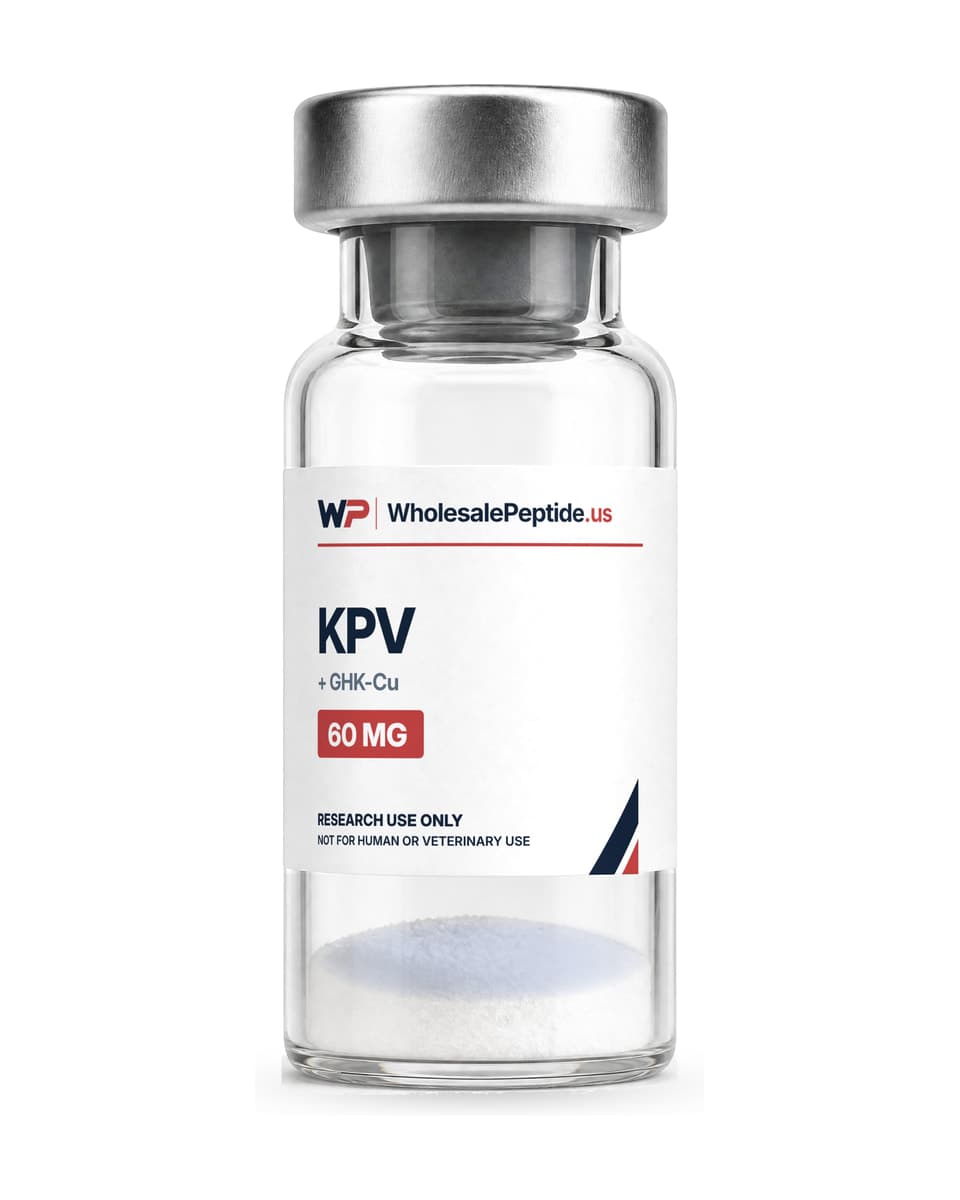
Illustrative product image. The label on each physical vial carries its lot code.
Wholesale KPV / GHK-Cu Blend pricing
The discount is set by the total kits in your order across all compounds. Per-vial price = kit price ÷ 10.
| SKU | Strength | 1–2 kits | 3–9 kits | 10–49 kits | 50–99 kits | 100+ kits |
|---|---|---|---|---|---|---|
| WP-KPVGHK-60 | 60 mg × 10 | $350.00 $35.00 / vial | $332.50 $33.25 / vial | $315.00 $31.50 / vial | $297.50 $29.75 / vial | Quote |
Compare every SKU on the wholesale price list.
Current lot and Certificate of Analysis
Certificate of Analysis — current lot
A lot-specific Certificate of Analysis is published before the lot ships. Lot record and lab report from an independent third-party laboratory will appear here.
All certificates: COA library · how to read a peptide COA · testing and quality · HPLC vs mass spec · storing lyophilized peptides
KPV / GHK-Cu Blend identity
The KPV / GHK-Cu blend is a multi-compound lyophilized research blend containing 10 mg KPV and 50 mg GHK-Cu per vial (60 mg total) in a fixed ratio in a single vial.
KPV / GHK-Cu Blend supplier, United States
WholesalePeptide.us is a U.S. KPV / GHK-Cu Blend supplier and vendor for laboratories, distributors and research resellers. Kits ship from Sheridan, WY by UPS / USPS, tracked; orders paid by 2:00 PM ET Monday–Friday leave the same day, typical transit is 1–4 business days, and orders over $500 ship free. Every kit label carries the lot code that matches its certificate from an independent third-party laboratory. For KPV / GHK-Cu Blend in quantities of 100+ kits, request a bulk quote; for your own label see private label peptides.
Research context
This product combines two tripeptides in one lyophilized vial: KPV, the C-terminal Lys-Pro-Val tripeptide of alpha-melanocyte-stimulating hormone, and GHK-Cu, the copper(II) complex of glycyl-L-histidyl-L-lysine. The supplier listing states the split as 10 mg of KPV and 50 mg of GHK-Cu per vial, 60 mg total, so that composition is stated here; the lot COA confirms each component's identity, purity and content independently of the label.
The two are paired because they sit on different but adjacent arms of tissue-remodeling research. GHK-Cu has the longer record: the glycyl-histidyl-lysine tripeptide was first described in 1973 in Biochemical and Biophysical Research Communications as a factor increasing survival of cultured normal liver cells, and a 2008 review in the Journal of Biomaterials Science collects the matrix-remodeling and connective-tissue literature built on it; its copper-coordination chemistry is central, because the copper(II) adduct, not the metal-free peptide, is the species most of that work describes. KPV is the much smaller signaling tripeptide: structure–activity work on α-MSH separated the hormone's pigmentary pharmacophore from an anti-inflammatory activity that survives in this three-residue C-terminal fragment, which in cell models suppresses NF-κB and MAP-kinase activation and pro-inflammatory cytokine output and enters epithelial cells through the PepT1 transporter. Grouping a matrix-active copper peptide with an anti-inflammatory tripeptide is the kind of comparative or combination design these are normally used for in cell and tissue models.
Pre-blended material has three practical advantages. The ratio is fixed at manufacture, so it is consistent from vial to vial. Each vial needs one reconstitution instead of two. And one lot COA covers both molecules: LC-MS identity is confirmed for each component, and RP-HPLC purity is reported for each component, under the same lot code.
What to check on the certificate, component by component. For GHK-Cu: that identity is reported for the copper(II) complex rather than the free apo-GHK peptide — the copper adduct and the metal-free peptide differ in mass and in UV–visible absorbance, and copper stoichiometry is the usual point of confusion. For KPV: the mass against the Lys-Pro-Val tripeptide; because it is so small, the counter-ion is a large fraction of the weighed mass, so the net peptide content matters when the real ratio in the vial is calculated. For both: individual per-peak RP-HPLC purity rather than a blend total, the counter-ion and net content for each, and the stated amounts — 10 mg KPV and 50 mg GHK-Cu — against the label.
Regulatory position, stated factually: neither component is an FDA-approved drug, and this blend is not a drug product. FDA lists GHK-Cu and KPV among bulk drug substances nominated for compounding, with several nominations withdrawn by the nominators; the HHS interim enforcement-discretion notice published in the Federal Register on October 30, 2026 addresses certain peptide bulk substances in 503A compounding pending rulemaking and is addressed to licensed compounders, not research suppliers, and is not an approval. Component amounts are stated on the lot COA. WholesalePeptide.us supplies this blend as a research reference material for in-vitro, analytical and preclinical laboratory research.
GHK-Cu gives the lyophilized cake and the reconstituted solution a blue tint, which is normal and comes from the copper complex. For a ratio other than the fixed 10 mg / 50 mg split, or for each tripeptide alone as a comparator, order KPV and GHK-Cu separately and combine them in your lab.
Research areas
- skin and connective-tissue remodeling models
- NF-κB and cytokine signaling in epithelial cell models
- copper-peptide coordination chemistry
- collagen and extracellular-matrix synthesis assays
- multi-component LC-MS identity testing
- per-component counter-ion and net-peptide-content checks
Handling and storage
- Store lyophilized vials at −20 °C, sealed, protected from light and moisture.
- Let the vial equilibrate to room temperature before opening to limit condensation.
- Reconstitute in an appropriate sterile buffer or solvent according to your laboratory SOP.
- The blue tint comes from the GHK-Cu copper complex. Reconstitute the whole vial once; both components are then in solution together. Aliquot and avoid repeated freeze–thaw.
KPV / GHK-Cu Blend wholesale FAQ
Can I buy the KPV / GHK-Cu blend wholesale?
Yes. the KPV / GHK-Cu blend is sold in 10-vial kits with a minimum order of one kit. Published price breaks apply at 3, 10 and 50 kits, and orders of 100+ kits are quoted within one business day. See wholesale pricing. All material is supplied for laboratory research use only.
How is purity reported for a two-component blend?
Each lot COA from an independent third-party laboratory lists LC-MS identity for both KPV and GHK-Cu and RP-HPLC purity for each component separately rather than as a blend total. Each component is released at 99%+. A lot-specific Certificate of Analysis is published before the lot ships. See the COA library.
Is the KPV / GHK-Cu blend approved by the FDA?
No. Neither component is an FDA-approved drug, and the blend is not a drug product. WholesalePeptide.us sells it as a research reference material only; For laboratory research use only. Not for human or veterinary use.
How is The KPV / GHK-Cu blend shipped?
The KPV / GHK-Cu blend ships as lyophilized powder in sealed vials via UPS / USPS, tracked. Orders paid by 2:00 PM ET Monday–Friday are dispatched the same day. We ship to U.S. addresses only. Details are on the shipping page.
What is the ratio of KPV to GHK-Cu in a vial?
The supplier listing states 10 mg of KPV and 50 mg of GHK-Cu per vial, 60 mg total. The per-component LC-MS identity and RP-HPLC purity lines on each lot COA document both molecules against that composition, with counter-ion and net content stated for each. For laboratory research use only. Not for human or veterinary use.
Sources
- PubChem compound record — KPV, CID 125672
- PubChem compound record — GHK-Cu, CID 71587328
- A synthetic tripeptide that increases survival of cultured normal liver cells — Biochemical and Biophysical Research Communications, 1973 (GHK)
- The human tripeptide GHK and tissue remodeling — Journal of Biomaterials Science, Polymer Edition, 2008
- PepT1-mediated tripeptide KPV uptake reduces intestinal inflammation — Gastroenterology, 2008
- FDA: certain bulk drug substances nominated for use in compounding, including the nominated-but-withdrawn table
Related research blends
Backorder
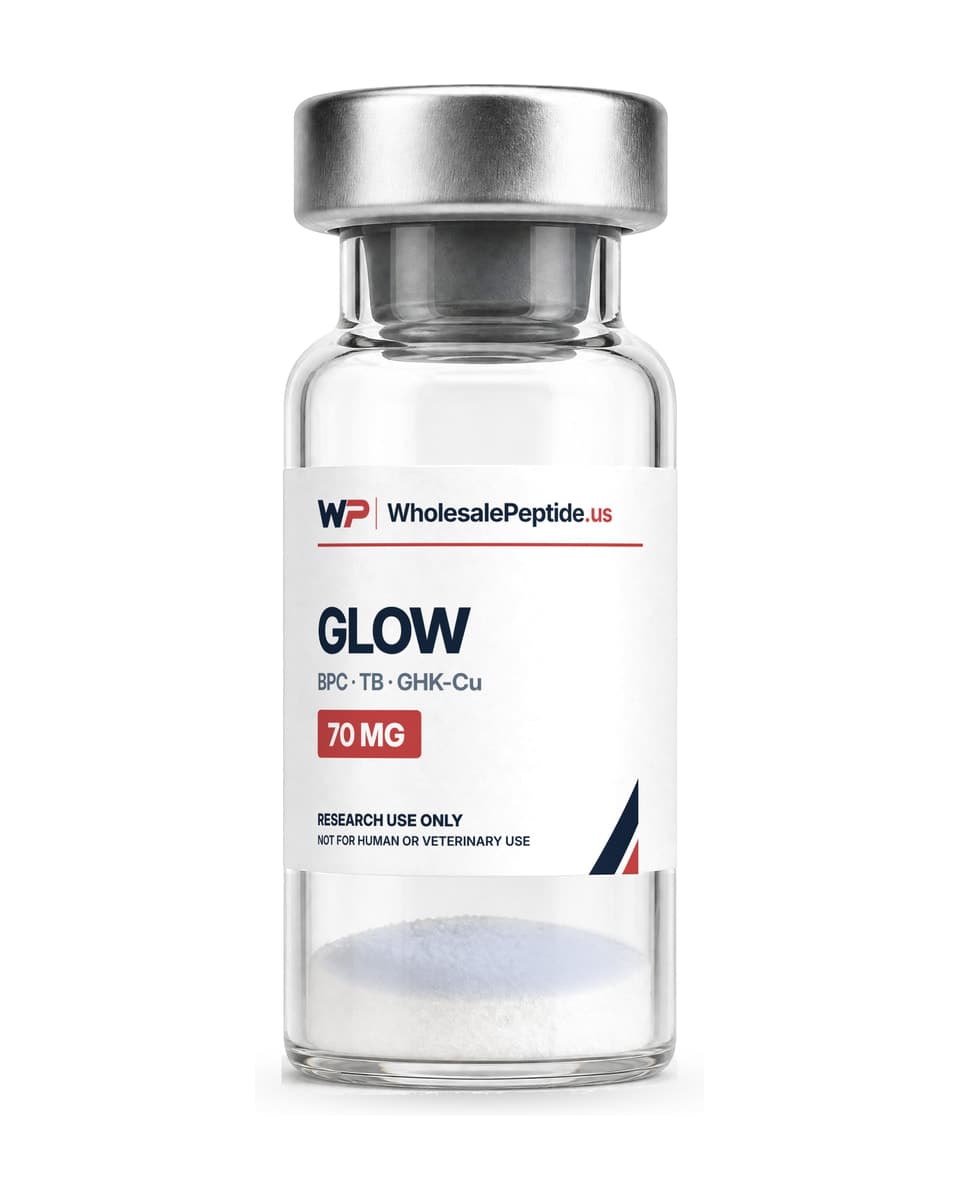
GLOW Blend (BPC-157 / TB-500 / GHK-Cu)
Research blends
70 mg
From
$48.50 / vial
Research use only
Most ordered
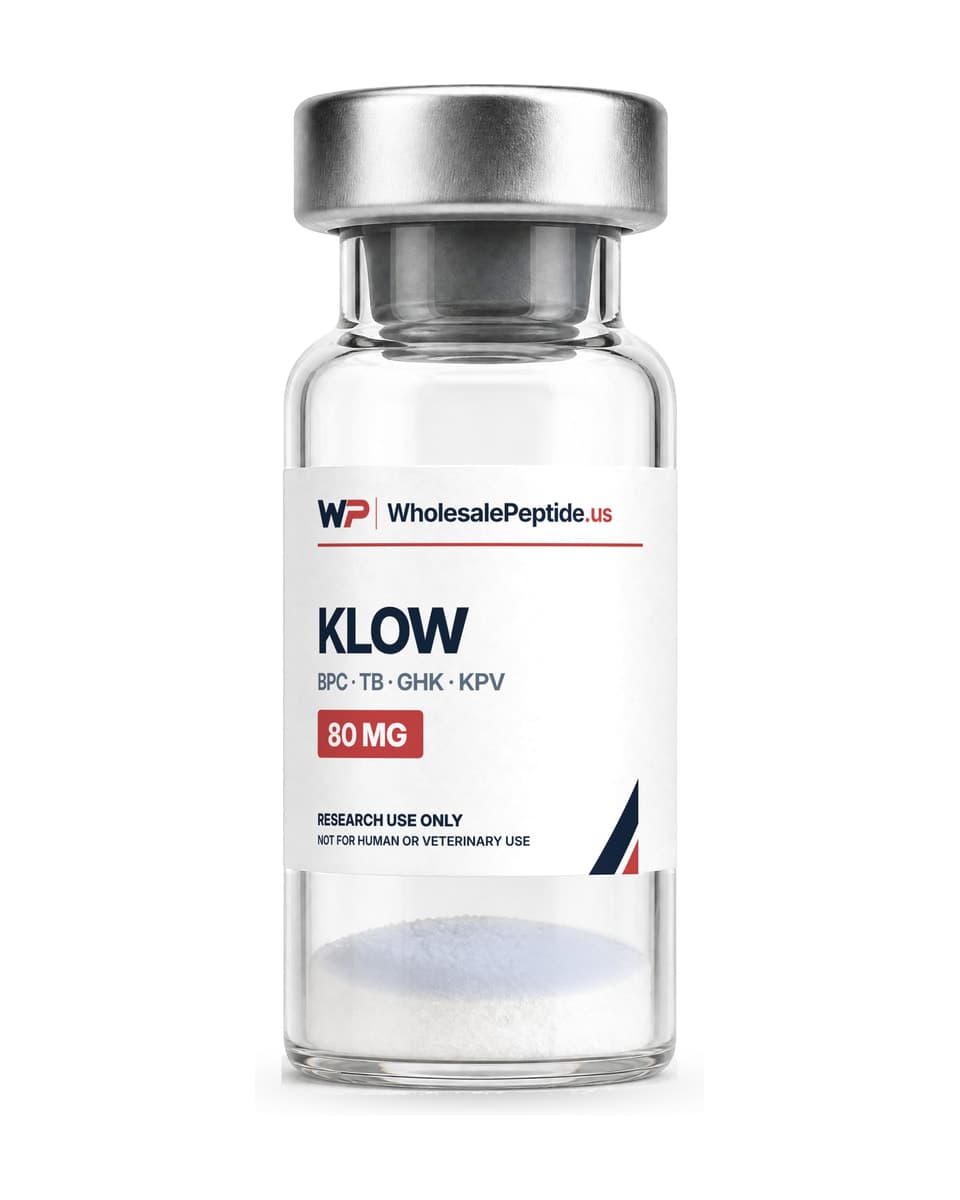
KLOW Blend (BPC-157 / TB-500 / GHK-Cu / KPV)
Research blends
80 mg
From
$51.00 / vial
Research use only
Back to wholesale peptides · full catalog · pricing
For laboratory research use only. Not for human or veterinary use.